Best practice exists for a reason. It helps businesses move faster, make informed decisions and avoid reinventing the wheel. But what happens when the standard approach no longer fits your business?
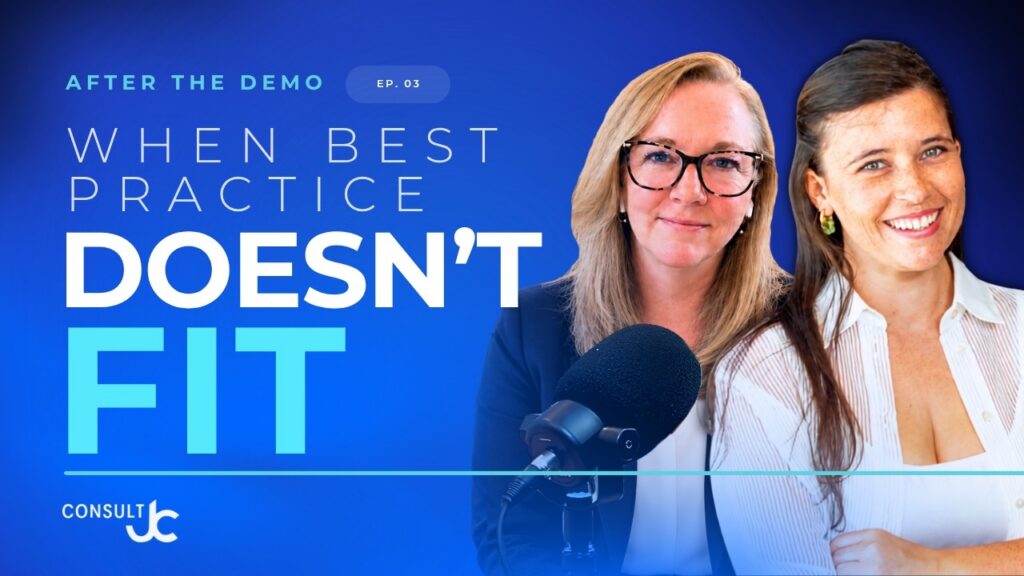
In the latest episode of After the Demo, host Christie Fourie welcomes our very first guest: Christina “Tina” Diodati, President and Managing Partner at Property Works. Tina is leading a technology and business transformation from inside her own organization, and she has lived these decisions in both a large enterprise and a smaller, fast-moving company.
Every transformation is a mix of out-of-the-box software and something more tailored. Christie asked Tina for three stories to unpack where each one belongs.
Before joining Property Works, Tina worked for an organization with a large salesforce. For years, the team ran on a homegrown CRM built by one of its own end users. It was a great piece of innovation, and because a colleague built it, people adopted it naturally.
The trouble came when the business outgrew it. The company moved to a major CRM platform with good practice built in, but end users expected it to work exactly like the old tool. So it was customized, heavily. A couple of years in, leadership realized they had taken an industry-standard solution and compromised their ability to scale it or adopt new releases.
The fix was a hard one: step back from the customization and return to something much closer to out-of-the-box, even after a significant investment. Tina credits the leadership team’s courage in making that call sooner rather than later.
Christie’s take: process takes years to mature. If you customize to every person’s idea of how work should get done, you can quickly end up in deep water.
The second story is happening right now at Property Works. The company is modernizing its platform to serve current clients better and reach a broader market. With a small but highly experienced IT team, the decision was made to build it internally.
About six months in, the reality was clear. The team could not run day-to-day operations, build a new platform and keep pace with AI all at once, at any reasonable velocity. Property Works made the difficult decision to outsource part of the build, and its technology leader took on a different role than first planned.
The change cost some time, but the new team was up and running in about six weeks. Looking back, Tina sees it as a smart choice for the whole business, not just the build. It freed up capacity for work on workforce management and client retention, and it took pressure off a leader who already carried a lot.
Christie points out how relevant this is in the age of AI, when many companies are tempted to self-implement or “vibe code” their way to a solution. Her signal to watch: as soon as time to value starts to slip, it is time to rethink your approach.
So how do you know when to stick with the standard and when to tailor? Tina starts with the 80/20 rule. A good solution should work for around 80% of what you do. For the other 20%, ask:
As Tina puts it, everybody thinks they are unique. Listen to your users, because they are closest to the work, but be willing to push back too. End users will not feel the long-term cost of a customization. Leaders will, every time an upgrade becomes harder or a simple change turns into a big project.
Where the standard is the better path, good change management helps people see a different way of working that does not threaten their role. Christie adds a reminder we share with clients often: technology can make a broken process faster, but it is still broken. Clean up your process and your data before you add AI.
One of the strongest moments in the episode is Tina’s view on revisiting decisions. Leaders often worry that changing direction a year into a project looks unstrategic. Tina argues the opposite: you have an obligation to revisit decisions, because the right standard at the start of a project may not be the right standard now, based on what you have learned.
That takes courage, and it takes the right indicators and data. Christie adds that it also takes knowing your markers of success. If you do not know what good looks like, it is very hard to get a project back on track.
Tina’s challenge is to open up communication within your leadership team. If you have a feeling about where a project is heading, there is a good chance someone else does too, even if it is not their swim lane to raise it. Practice these conversations in small moments now, so that when the big decisions come, your team already approaches them with an open mind. No sacred cows, just decisions grounded in facts, realities and strategy.
Watch Where Best Practice Ends and Your Context Begins on the Consult JC YouTube channel, and subscribe so you do not miss the next conversation. If it resonates, share it with a decision maker on your team.
If you are weighing up best practice against your own business needs, we would love to help you find the right balance. Book a free consultation at consultjc.com or email info@consultjc.com.
People first. Systems that scale.